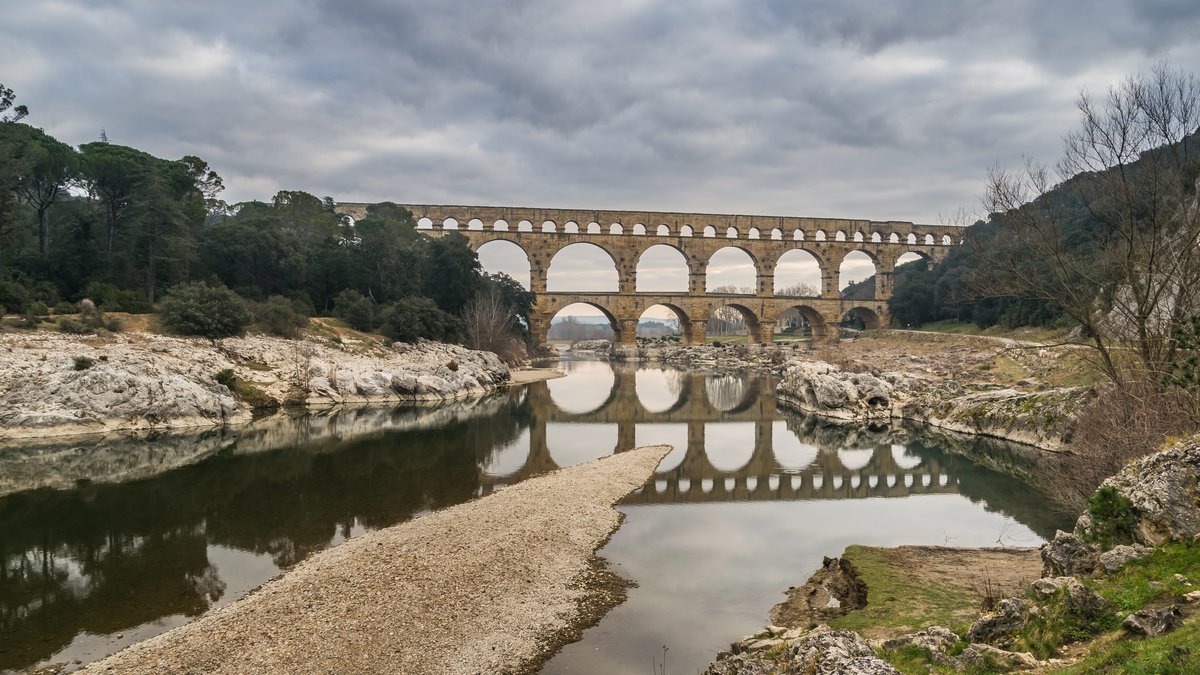
The history of human civilization is fundamentally the history of infrastructure. Before governments, financial systems, or digital algorithms, humanity required clean water, secure shelter, reliable transport routes, and agricultural irrigation to survive. The journey of infrastructure history—from ancient Mesopotamian irrigation canals and Roman pozzolanic concrete aqueducts to 19th-century steam railways and 21st-century smart megacities—reflects humanity’s relentless quest to reshape raw planetary geology to serve societal needs.
Historical Milestones at a Glance
- Hydraulic Foundations (3000 BCE – 500 BCE): Early urban civil societies in Mesopotamia, the Indus Valley, and Persia thrived exclusively through mastery of irrigation channels, subterranean qanats, and urban covered sewer grids.
- The Roman Structural Leap (300 BCE – 400 CE): Roman engineers revolutionized the built environment by inventing hydraulic pozzolanic concrete (opus caementicium) and mastering the true stone arch, creating aqueducts and military roads that endure after two millennia.
- The Industrial Revolution (1750 – 1900): The invention of Portland cement, structural wrought iron, steam locomotion, and Brunel’s tunneling shield transformed civil engineering into an empirical scientific discipline.
- The Megaproject Century (1900 – 2000): The 20th century witnessed continental-scale public works: massive concrete dams (Hoover, Grand Coulee), intercontinental highways (US Interstate, German Autobahn), and global canals (Panama, Suez).
Table of Contents
- 1. Ancient Civilizations: The Genesis of Hydraulic and Urban Civil Works
- 2. The Roman Empire: Concrete, Arches, and Continental Roadways
- 3. The Medieval and Early Modern Eras: Canals and Masonry Bridges
- 4. The Industrial Revolution: Iron, Steam, and Empirical Engineering
- 5. The 20th Century: The Century of Megastructures
- 6. Chronological Evolution of Human Civil Infrastructure
- 7. Lessons from History: Catastrophes that Reshaped Engineering Codes
- 8. Frequently Asked Questions (FAQ)
- 9. Conclusion: The Ever-Evolving Architecture of Civilization
1. Ancient Civilizations: The Genesis of Hydraulic and Urban Civil Works
Infrastructure originated in the fertile river valleys of the ancient world. Without organized civil works, agriculture was at the mercy of catastrophic river floods and punishing desert droughts.
Mesopotamia and the Indus Valley (3500 BCE – 1900 BCE)
In the arid plains between the Tigris and Euphrates rivers, the Sumerians engineered complex networks of earthen canals, gravity-fed diversion weirs, and retention reservoirs. By regulating floodwaters, they produced the agricultural surpluses required to sustain humanity’s first true cities, such as Uruk and Ur.
Concurrently, in the Indus River Valley (modern-day Pakistan and northwest India), the cities of Harappa and Mohenjo-daro introduced modern urban sanitary infrastructure around 2600 BCE. Long before European cities adopted underground drainage, Harappan engineers constructed:
- Standardized kiln-fired clay bricks with an exact dimensional ratio of 4:2:1 for optimal interlocking masonry strength.
- Sophisticated covered street drain channels lined with precision-fitted bricks and corbelled arches.
- Private household latrines connected directly via terracotta pipes to street sewer mains, complete with inspection sump pits to trap solid sediment.
- The legendary Great Bath of Mohenjo-daro, waterproofed using a thick layer of natural bitumen (asphalt mastic) sandwiched between two courses of brickwork—the earliest recorded use of synthetic waterproofing membranes in civil engineering history.
The Persian Qanats (1st Millennium BCE)
In the arid plateaus of ancient Persia (Iran), engineers solved the problem of desert evaporation by inventing the Qanat. A qanat is a gravity-fed subterranean aqueduct tapping into an alluvial mountain aquifer. Persian miners excavated horizontal underground channels spanning up to 70 kilometers with gentle downward slopes of 1:1,000 to 1:1,500. Vertical ventilation and maintenance shafts were sunk every 30 to 50 meters. Operating entirely on gravity without mechanical pumps, thousands of Persian qanats continue to supply agricultural water across the Middle East today, proving the extraordinary durability of subterranean design. (Discover how modern engineers scale these techniques into mega-tunnels in our guide to Tunnels and Underground Structures).
Ancient China: The Dujiangyan Irrigation System (256 BCE)
In Sichuan Province, the civil engineer Li Bing faced the violent seasonal floods of the Min River. Rather than building a conventional dam—which would trap silt and eventually burst—Li Bing designed the revolutionary Dujiangyan Irrigation System. By carving a channel through Mount Yulei (using thermal cracking by heating rock with fire and dousing it with water) and constructing a central artificial island called the Fish Mouth, Li Bing split the river into an inner irrigation canal and an outer floodway. Utilizing natural centrifugal river flow to automatically bypass sediment, Dujiangyan has operated continuously for over 2,280 years without a dam, irrigating over 5 million hectares of the Chengdu Plain.
2. The Roman Empire: Concrete, Arches, and Continental Roadways
No ancient empire shaped the trajectory of civil infrastructure more profoundly than Rome. Roman engineering superiority was built on three technical pillars: hydraulic concrete, the true arch, and disciplined standardization.
| Roman Civil Innovation | Technical Mechanics | Historical Infrastructure Impact |
|---|---|---|
| Pozzolanic Concrete (Opus Caementicium) | Hydraulic blend of slaked lime, volcanic ash (pozzolana) from Pozzuoli, and volcanic tuff aggregates. | Allowed underwater setting in marine harbors; formed self-healing calcium-aluminum-silicate-hydrate (C-A-S-H) crystals lasting millennia. |
| The Multi-Tiered Stone Arch | Wedge-shaped voussoirs redirecting vertical weight into lateral compressive thrust. | Allowed high-elevation aqueducts (Pont du Gard, Segovia) to span deep river valleys with minimal stone volume. (See how this principle continues in modern Bridge Types and Structural Arches). |
| Layered Roman Highway (Via Militaris) | 4-layered structural cross-section: statumen, rudus, nucleus, and polygonal basalt pavimentum. | Over 80,000 km of paved military expressways connected Britannia to Egypt, establishing the foundation for modern Roads and Highway Engineering. |
The Miracle of Roman Aqueduct Hydraulics
Rome was supplied by eleven major aqueduct systems spanning over 500 kilometers, delivering over 1 million cubic meters of fresh mountain spring water daily—more potable water per capita than many modern cities. Roman engineers (such as Frontinus, Water Commissioner of Rome) maintained steady hydraulic gradients between 0.1% and 0.3% over tens of kilometers using subterranean masonry channels, pressurized inverted siphons (lead pipes withstanding up to 18 atmospheres of pressure), and tiered stone arches across valleys.
3. The Medieval and Early Modern Eras: Canals and Masonry Bridges
Following the decline of the Western Roman Empire, European infrastructure fragmented. However, monumental civil works flourished in the Islamic Golden Age and China, later returning to Europe during the Renaissance.
The Grand Canal of China (Sui Dynasty, 605 CE)
Spanning over 1,770 kilometers, the Grand Canal of China remains the longest artificial waterway in human history. Engineered to connect the Yangtze and Yellow River basins, the canal mobilized millions of workers to transport grain from the agricultural south to the imperial capitals of the north. In 984 CE, Chinese engineer Qiao Weiyue invented the pound lock (featuring two gates), allowing barges to ascend steep elevation changes safely—a technology that would later define European and American canal booms.
The Renaissance and the Canal du Midi (1681)
In 17th-century France, Pierre-Paul Riquet engineered the Canal du Midi, spanning 240 kilometers between the Atlantic Ocean and the Mediterranean Sea. The project required constructing 91 locks (including Leonardo da Vinci’s miter lock gates), the world’s first canal tunnel (Malpas Tunnel, 173 meters bored through solid shale), and the Bassin de Saint-Ferréol—the largest artificial earthfill reservoir dam of its time, equipped with innovative bottom sluice drain gates.
4. The Industrial Revolution: Iron, Steam, and Empirical Engineering
Between 1750 and 1900, the Industrial Revolution fundamentally decoupled civil engineering from empirical guesswork, transforming it into a rigorous mathematical science based on physics and calculus.
The Birth of the Civil Engineering Profession
In 1771, John Smeaton—builder of the third Eddystone Lighthouse—coined the term “Civil Engineer” to distinguish civilian infrastructure builders from military combat engineers. In 1818, the Institution of Civil Engineers (ICE) was founded in London, with Thomas Telford serving as its first president. Smeaton’s rediscovery of hydraulic lime and Joseph Aspdin’s 1824 patent for Portland Cement laid the material foundation for modern concrete.
The Metal Structural Revolution: From Iron to Steel
In 1779, the world’s first cast-iron bridge—the Iron Bridge at Coalbrookdale, England—spanned 30 meters across the River Severn, proving that industrial metals could replace masonry arches. Within a century, the development of the Bessemer process and open-hearth furnace replaced brittle cast iron with high-tensile structural steel, making possible the soaring railway bridges of the late 19th century, culminating in the 1890 Forth Bridge in Scotland (the world’s first major all-steel cantilever structure).
Isambard Kingdom Brunel and the Railway Age
The 19th century was defined by the rapid expansion of railways. In Great Britain, Isambard Kingdom Brunel pushed civil engineering to unprecedented heights on the Great Western Railway:
- Engineering the 3.2 km Box Tunnel through treacherous Bath stone with laser-straight alignment.
- Constructing the soaring Clifton Suspension Bridge across the Avon Gorge.
- Laying down high-speed broad gauge tracks with gentle gradients that set world records for passenger train velocities.
Sir Marc Brunel’s Tunneling Shield and Bazalgette’s Sewers
In 1843, Sir Marc Isambard Brunel completed the Thames Tunnel in London—the first successful tunnel beneath a navigable river. Brunel invented the revolutionary tunneling shield, inspired by the wood-boring shipworm (Teredo navalis). His iron shield protected miners from soft mud collapses while bricklayers laid masonry rings directly behind it, birthing the mechanized Tunnel Boring Machines (TBMs) of today.
A few years later, in 1858, London was paralyzed by the “Great Stink”—the unbearable stench of raw sewage filling the River Thames, triggering cholera epidemics that killed tens of thousands. Chief Engineer Sir Joseph Bazalgette designed a monumental underground civil infrastructure network: 1,800 kilometers of street sewers feeding into 132 kilometers of brick-lined intercepting trunk sewers. Bazalgette’s massive hydraulic conduits washed sewage far downstream to the Thames estuary, instantly eradicating cholera from London and establishing the blueprint for modern urban sanitation worldwide.
5. The 20th Century: The Century of Megastructures
The 20th century was defined by exponential population growth, urbanization, and the rise of the automobile, driving governments to execute public works projects of unprecedented continental scale.
Mega-Dams and Hydroelectric Transformation
Completed in 1936 in the Black Canyon of the Colorado River, the Hoover Dam became the supreme symbol of modern civil engineering. Standing 221 meters tall, it was the largest concrete structure on Earth, requiring 2.48 million cubic meters of concrete. Engineers pioneered artificial refrigeration cooling pipes inside mass concrete blocks to prevent destructive thermal cracking and developed advanced arch-gravity finite element models. (Read our dedicated technical treatise on Dams & Hydraulic Infrastructure).
Continental Highway Networks
In the United States, President Dwight D. Eisenhower signed the Federal-Aid Highway Act of 1956, launching the Interstate Highway System. Spanning over 75,000 kilometers (46,876 miles), it is the largest and most expensive public works project in American history. Standardized with grade-separated diamond interchanges, minimum 12-foot travel lanes, 70 mph design speeds, and heavy-duty concrete pavements, the Interstate unified continental commerce, reduced transit times by 70%, and spurred suburban development.
Interoceanic Canal Engineering: The Panama Canal (1914)
Cutting through the continental divide of Central America, the Panama Canal conquered yellow fever, mountainous landslides at the Culebra Cut, and tropical torrential storms. Civil engineer George Washington Goethals engineered an 80-kilometer waterway utilizing an elevated artificial lake (Gatun Lake) and three pairs of monumental concrete gravity locks, slashing maritime trade routes between the Atlantic and Pacific oceans by 13,000 kilometers.
6. Chronological Evolution of Human Civil Infrastructure
| Historical Era | Core Structural Material | Defining Engineering Breakthrough | Global Paradigm Shift |
|---|---|---|---|
| Bronze / Iron Age (3000–500 BCE) | Sun-dried & kiln brick, timber, bitumen | Irrigation diversion weirs, subterranean qanats | Agricultural stability & earliest urban settlements |
| Classical Roman (300 BCE–400 CE) | Pozzolanic concrete, dressed stone, lead | Arched aqueducts, barrel vaults, paved highways | Continental empire integration & urban sanitation |
| Industrial Era (1750–1900 CE) | Cast iron, wrought iron, early Portland cement | Steam railways, tunneling shield, deep brick sewers | Velocity of heavy freight & eradication of waterborne disease |
| 20th Century Megaprojects | Reinforced concrete, structural steel, asphalt | Mega-dams, Interstate expressways, interoceanic locks | Globalized supply chains & nationwide electrification |
| 21st Century Digital-Physical | UHPC, geopolymer concrete, carbon composites | High-speed rail, automated TBMs, digital twins, InSAR | Climate resilience, cyber-physical integration, decarbonization |
7. Lessons from History: Catastrophes that Reshaped Engineering Codes
Civil engineering progress has often been forged in the crucible of structural failure. Tragic collapses exposed the limits of existing theory and forced regulatory standards to evolve:
- The Quebec Bridge Collapses (1907 & 1916): In 1907, the world’s longest cantilever bridge collapsed during construction, killing 75 workers. The tragedy was traced to underestimating the bridge’s deadweight by 20% and inadequate latticing on compression chords. The disaster led directly to the creation of rigorous peer review mandates and professional engineering licensure (PE / P.Eng.) worldwide.
- The St. Francis Dam Disaster (1928): A 60-meter concrete gravity dam near Los Angeles collapsed upon its first full filling, killing over 400 people. Chief Engineer William Mulholland had failed to recognize that the dam’s western abutment was founded on paleolithic red conglomerate rock that dissolved into mud when submerged in water. This catastrophe birthed modern engineering geology and mandatory independent dam safety inspections.
- The Tacoma Narrows Bridge Collapse (1940): The aeroelastic flutter of this suspension bridge destroyed the illusion that bridges could be designed purely for static vertical gravity loads, mandating aerodynamic wind tunnel testing for every long-span bridge built thereafter.
8. Frequently Asked Questions (FAQ)
Q1: Why was Roman concrete more durable than modern concrete?
Roman concrete utilized volcanic ash (pozzolana) containing reactive aluminosilicates and unslaked quicklime clasts. When seawater or rainwater infiltrated micro-cracks, it dissolved the lime, precipitating calcium-aluminum-silicate-hydrate (C-A-S-H) and rare platy tobermorite crystals that physically “healed” the crack. In contrast, modern reinforced concrete contains internal steel rebar which corrodes, expands, and spalls when exposed to moisture.
Q2: What is considered the oldest surviving paved road in the world?
The Lake Moeris Quarry Road in Egypt, dating to approximately 2600 BCE, is considered the oldest known engineered paved road. Spanning 12 kilometers, it was constructed from slabs of basalt and limestone over a log-supported subgrade to haul heavy stone blocks from basalt quarries to the Nile River.
Q3: Who is recognized as the father of modern civil engineering?
English engineer John Smeaton (1724–1792) is universally regarded as the father of civil engineering. He was the first person to formally describe himself as a “Civil Engineer,” conducted empirical scientific experiments on watermills and hydraulic lime, and established professional engineering societies.
9. Conclusion: The Ever-Evolving Architecture of Civilization
Infrastructure is the enduring physical testament to human aspiration. From the stone-cut irrigation sluices of ancient Mesopotamia and the unyielding arches of Roman aqueducts to the sprawling intercontinental highways and computerized high-speed rail viaducts of the modern era, each generation builds upon the empirical discoveries and structural lessons of the past. As we confront the challenges of the 21st century—urban population surges, rising sea levels, and the imperative for carbon neutrality—the history of civil infrastructure reminds us that humanity’s greatest achievements have always been born from bold engineering, scientific rigor, and an unwavering commitment to the public good.


3 thoughts on “From Roman Aqueducts to Megacities: The Epic History of Human Civil Infrastructure”