Every monumental civil structure—from towering megatalls to long-span suspension bridges—is only as dependable as the subterranean soil and bedrock beneath it. Geotechnical foundation engineering is the discipline of transferring thousands of tonnes of structural vertical, lateral, and uplift forces safely into deep subterranean geological strata without catastrophic settlement or shear failure.
Core Geotechnical Foundations Principles
- End Bearing vs. Skin Friction: Deep piles transfer structural weight through two mechanical pathways: tip resistance (end bearing) seated on hard bedrock, and peripheral shearing friction (side resistance) developed along the soil-pile interface.
- Drilled Shafts (Bored Piles): Large-diameter reinforced concrete cylinders (up to 3.5 meters in diameter and 100+ meters deep) excavated under polymer or bentonite drilling slurries to prevent borehole collapse.
- Osterberg Cell (O-Cell) Testing: Sacrificial bi-directional hydraulic jacks cast directly into the bottom of test piles, applying upwards of 30,000 tonnes of force to independently measure end bearing and skin friction without heavy surface kentledge reaction frames.
Table of Contents
- 1. Shallow vs. Deep Foundations: Structural Selection Criteria
- 2. Driven Piles vs. Drilled Shafts (Bored Piles)
- 3. Marine Caissons and Deep Water Foundations
- 4. High-Strain Dynamic Pile Testing (PDA & CAPWAP)
- 5. Soil Liquefaction and Seismic Foundation Countermeasures
- 6. Frequently Asked Questions (FAQ)
- 7. Conclusion: Anchoring Humanity’s Megastructures
1. Shallow vs. Deep Foundations: Structural Selection Criteria
When the near-surface soil possesses adequate bearing capacity, civil engineers utilize shallow foundations (isolated footings, strip footings, or monolithic reinforced concrete raft slabs). However, when surface strata consist of weak alluvial silts, soft marine clays, or uncontrolled urban fill, shallow foundations would experience catastrophic differential settlement.
In these challenging sites, engineers bypass weak upper soils using deep foundations, extending dozens of meters down into competent rock. The ultimate axial compressive capacity ($Q_{ult}$) of a deep pile is expressed as:
where $q_b$ is unit base bearing capacity, $A_b$ is cross-sectional tip area, $f_s$ is unit side skin friction, and $A_s$ is circumferential surface area along each soil layer.
2. Driven Piles vs. Drilled Shafts (Bored Piles)
Deep foundations generally fall into two primary construction typologies:
- Driven Displacement Piles: Pre-cast prestressed concrete piles, steel H-piles, or closed-ended steel pipes driven into the ground using hydraulic impact hammers or vibratory drivers. Driving compacts surrounding granular soils, increasing soil density and skin friction, but generates intense ground vibrations prohibited in historic urban cores.
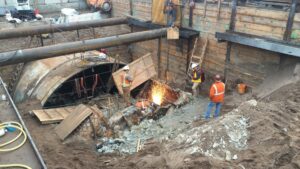
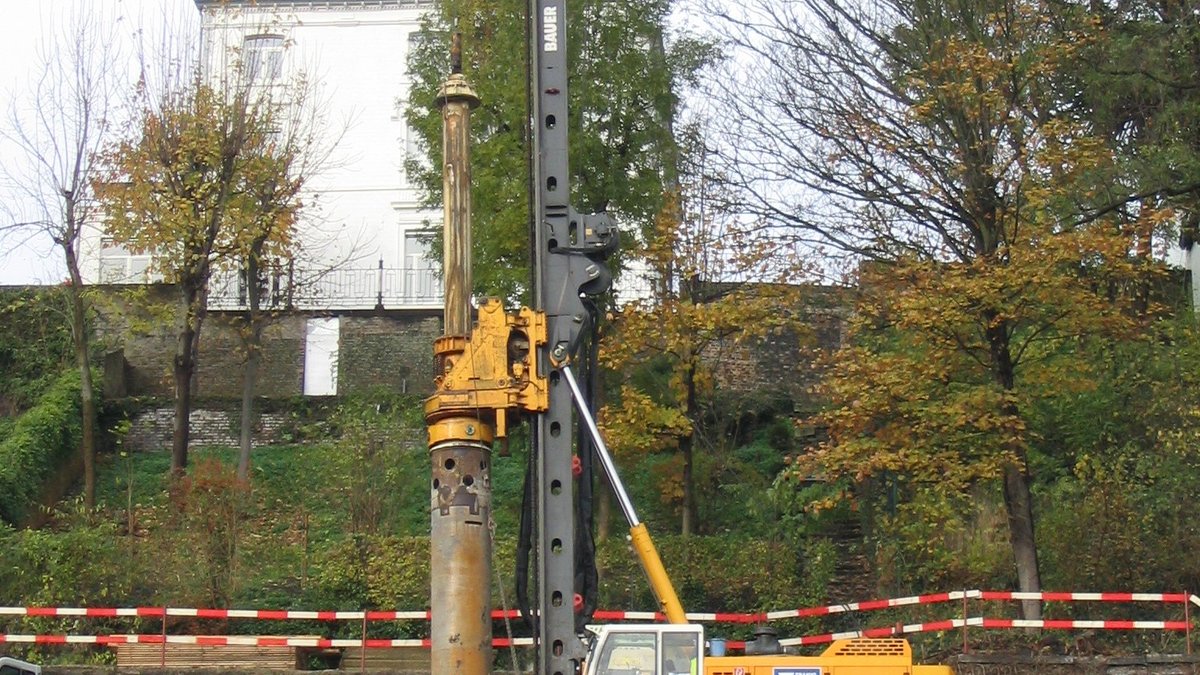
- Drilled Shafts (Bored Piles / Cast-in-Drilled-Hole – CIDH): High-torque rotary drilling rigs bore deep cylindrical shafts using specialized augers and clean-out buckets. In water-bearing soils, high-viscosity mineral (bentonite) or synthetic polymer slurries fill the borehole during drilling to exert hydrostatic support against the borehole walls, preventing cave-ins. Once the hole reaches target rock socket depth, a full-length welded steel rebar cage is hoisted inside, and self-consolidating concrete is pumped via tremie pipe from the bottom up, displacing the lighter slurry out the top.
3. Marine Caissons and Deep Water Foundations
For mega-bridges crossing broad marine straits, driven piles are often insufficient to resist horizontal ship collision impacts and wave drag. Engineers deploy Deepwater Pneumatic or Open Caissons—monolithic reinforced concrete multi-cell structures that are sunk by progressively excavating riverbed sediment from interior dredge wells under controlled hydrostatic ballast. (For bridge pier applications, review our guide to Bridges and Civil Infrastructure).
4. High-Strain Dynamic Pile Testing (PDA & CAPWAP)
To verify that installed piles achieve their design capacity without waiting weeks for slow static load tests, geotechnical engineers employ the Pile Driving Analyzer (PDA). A heavy drop weight strikes the top of the pile while high-precision strain transducers and piezoresistive accelerometers record force and velocity shockwaves. The data is processed through CAPWAP (Case Pile Wave Analysis Program) signal-matching software, back-calculating mobilized end bearing and skin friction with 95%+ correlation to static tests.
5. Soil Liquefaction and Seismic Foundation Countermeasures
During a major earthquake, cyclic ground shaking causes pore water pressure inside loose, saturated sands to surge violently. When pore pressure equals total overburden stress, the effective stress drops to zero—the soil completely loses its shear strength and behaves like a liquid, a catastrophic phenomenon known as soil liquefaction.
Civil engineers mitigate liquefaction through ground improvement:
- Vibro-Replacement Stone Columns: Sinking massive vibrating probes deep into loose soil and backfilling with crushed angular rock to densify surrounding sand while providing rapid pore-pressure relief drainage channels.
- Jet Grouting: Injecting high-pressure cement grout to create interlocking subterranean soil-cement grids that physically confine loose sand lenses. (See also Tunnels and Underground Works).
6. Frequently Asked Questions (FAQ)
Q1: What is “negative skin friction” on a pile?
If soft surrounding soil settles more rapidly than the pile (due to groundwater table drawdown or heavy surface fill), the soil drags downward against the pile perimeter. Instead of supporting the pile, the friction adds extra downward load, known as negative skin friction (downdrag), which can overload foundation piles if not factored into design.
Q2: What is a rock socket in deep foundations?
A rock socket is the portion of a drilled shaft that is bored directly into solid unweathered bedrock below soil strata, developing immense shear bonding along the rock-concrete interface to resist high axial and overturning forces.
Q3: How deep can modern drilled shaft foundations reach?
Modern mega-projects (such as sea-crossing bridge towers and supertall skyscrapers) routinely drill foundation shafts between 60 and 100+ meters (200 to 330 feet) deep, with diameters up to 3.0 to 3.5 meters.
7. Conclusion: Anchoring Humanity’s Megastructures
Deep foundation engineering is the unseen guarantor of structural safety. By deciphering complex subsurface soil mechanics and executing high-precision drilled and driven shafts, geotechnical engineers ensure that our greatest infrastructure achievements remain permanently anchored into the earth.