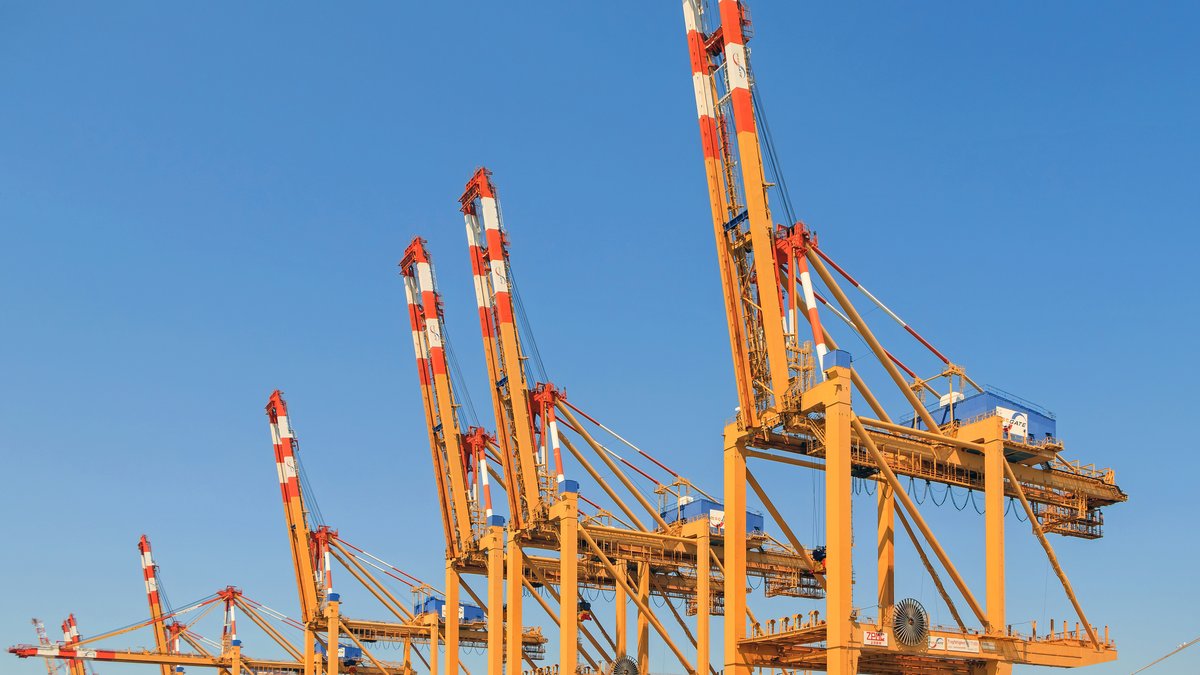
Over 80% of global trade by volume travels across the oceans. Ports and maritime infrastructure serve as the vital interface between marine freight lanes and terrestrial transportation networks. Designing deepwater container terminals, offshore breakwaters, and heavy-duty quay walls requires civil engineers to master wave hydrodynamics, marine geotechnical stability, and electrochemical corrosion in harsh saline environments.
Core Maritime Engineering Realities
- Vessel Scale Escalation: Ultra-Large Container Vessels (ULCVs) exceeding 24,000 TEU possess drafts over 16.5 meters and lengths of 400 meters, requiring port authorities to dredge approach channels to -18m to -20m CD (Chart Datum) and engineer quay walls resisting immense berthing energy.
- Quay Wall Typologies: Deepwater berths utilize monolithic gravity concrete caissons, diaphragm walls with ground anchors, or suspended open-pile combi-walls to retain millions of tonnes of soil pressure.
- Wave Attenuation: Offshore rubble-mound breakwaters armored with interlocking concrete armor units (such as Core-loc, Accropode, or Tetrapods) dissipate destructive 100-year storm wave energy through controlled hydraulic void turbulence.
Table of Contents
- 1. Deepwater Quay Wall Engineering & Retaining Mechanics
- 2. Breakwater Design & Wave Hydrodynamics
- 3. Ship Berthing Kinematics & High-Performance Fenders
- 4. Navigational Dredging & Marine Environmental Management
- 5. Automated Container Terminal Yard Pavements
- 6. Frequently Asked Questions (FAQ)
- 7. Conclusion: Anchoring Global Commerce
1. Deepwater Quay Wall Engineering & Retaining Mechanics
A quay wall is essentially a massive vertical retaining structure that must simultaneously resist lateral earth pressure from behind, live surcharge loads from container stacking yards, and hydraulic differential water heads caused by tidal fluctuations.
Primary Structural Quay Wall Designs
- Reinforced Concrete Gravity Caissons: Massive hollow rectangular concrete boxes (often 30 meters tall, 20 meters wide, weighing 5,000+ tonnes) pre-fabricated in dry docks, towed by tugboats to the berth alignment, and ballasted with sand into an engineered rubble foundation trench.
- Combi-Walls (Steel Tubular King Piles & Sheet Piling): Large-diameter steel tubular piles (up to 2.5 meters in diameter) driven deep into the seabed, interconnected with intermediate Z-sheet piles. The wall is restrained by heavy high-tensile steel tie rods anchored to a subterranean anchor wall 40 meters inland.
- Open Piled Jetties: Supported on vertical and raked concrete or steel tubular piles, allowing tidal currents and waves to pass freely beneath the suspended deck, minimizing hydrodynamic resistance in soft seabed environments. (For foundation pile mechanics, review our technical guide to Subterranean and Geotechnical Works).
2. Breakwater Design & Wave Hydrodynamics
Without calm harbor waters, container cranes cannot safely hoist 40-foot containers off rocking vessels. Breakwaters serve as engineered energy barriers against ocean swells.
Modern coastal engineers design Rubble-Mound Breakwaters with Precast Concrete Armor Units:
The Hudson Formula & Armor Stability
The required mass ($W$) of individual armor units protecting a breakwater slope is calculated using the Hudson Formula:
where $H$ is the design wave height, $\gamma_r$ is armor density, and $K_D$ is the stability coefficient. Complex interlocking shapes—such as Accropode or Core-loc—exhibit high $K_D$ values (up to 15–16), interlocking mechanically to form a porous slope that dissipates wave energy through internal friction rather than brute mass.
3. Ship Berthing Kinematics & High-Performance Fenders
When a fully laden 200,000-tonne container vessel approaches a berth, even at a crawl speed of only 0.15 m/s (0.3 knots), its kinetic berthing energy ($E_k$) is immense:
where $C_e$ is the eccentricity coefficient, $C_m$ is hydrodynamic virtual added mass, and $C_s$ is structural softness.
To prevent this energy from punching through the concrete quay wall or buckling the ship’s hull, engineers mount high-deflection Cone or Super-Cell Elastomeric Rubber Fenders with ultra-high molecular weight polyethylene (UHMW-PE) frontal panels, safely absorbing mega-joules of impact energy while capping reaction forces.
4. Navigational Dredging & Marine Environmental Management
Maintaining access for deep-draft vessels requires continuous capital and maintenance dredging. Giant Trailing Suction Hopper Dredgers (TSHD) and Cutter Suction Dredgers (CSD) excavate millions of cubic meters of seafloor silt and rock.
Modern coastal projects utilize dredged marine sediment beneficially for land reclamation—pumping sand into containment bunds to create artificial peninsulas and new container terminals (as seen in Singapore’s Tuas Mega Port and Rotterdam’s Maasvlakte 2).
5. Automated Container Terminal Yard Pavements
Container yard pavements experience extreme wheel loads from Automated Guided Vehicles (AGVs) and heavy container stacking weights (up to 120 tonnes beneath a 5-high container corner casting). Port engineers install heavy-duty Interlocking Concrete Block Pavements (ICBP) over cement-treated bases. Segmental concrete blocks can absorb minor settlement without cracking and permit individual block replacement during underground utility maintenance.
6. Frequently Asked Questions (FAQ)
Q1: How do engineers prevent marine concrete from corroding in saltwater?
Engineers use high-performance concrete mixes with supplementary cementitious materials (slag and silica fume) to achieve ultra-low chloride permeability, apply silane hydrophobic coatings, increase rebar concrete cover to 75mm+, and install Impressed Current Cathodic Protection (ICCP) systems on marine steel piles.
Q2: What is the difference between a jetty, a pier, and a quay?
A quay runs parallel to the natural coastline, backed by solid earth. A pier or jetty projects perpendicular or at an angle out into open water, providing berths on both sides and allowing tidal currents to pass underneath.
Q3: How deep are modern container ports?
Major global hub ports (like Singapore, Rotterdam, and Shanghai) maintain water depths between -16.5 meters and -20.0 meters Chart Datum to accommodate fully loaded 24,000 TEU container ships regardless of tidal conditions.
7. Conclusion: Anchoring Global Commerce
Port and maritime infrastructure represents the linchpin of globalized trade. Through the rigorous integration of deepwater geotechnical engineering, computational wave modeling, and automated port logistics, civil engineers continue to push the boundaries of oceanic connectivity.